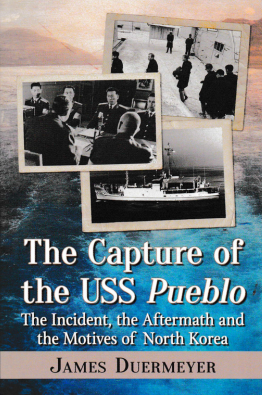
THE CAPTURE OF THE USS PUEBLO: The Incident, the Aftermath, and the Motives of North Korea
By James Duermeyer
For President Lyndon Johnson, 1968 was a year of calamity, including the hijacking of the USS Pueblo in international waters off North Korea. After a fierce attack by the North Korean Navy, the lightly armed spy ship was captured and its 83 American crewmen taken hostage, imprisoned and tortured in North Korea for nearly a year before being released.
How and why did the Navy, the National Security Agency and the Johnson administration place the Pueblo in such an untenable situation? What drove Kim Il-sung, North Korea’s autocrat to gamble on hijacking a ship belonging to the world’s most powerful nation?
Drawing on extensive research, including summaries of White House meetings and conversations, the author answers these questions and reviews the events and flawed decisions that led to Pueblo’s capture.
James Duermeyer is the award-winning author of five historical novels. He is a retired U.S. Navy Commander and lives in the Fort Worth area of Texas.
REVIEWS & ENDORSEMENTS
NAUTICAL RESEARCH JOURNAL, June 2020
For me, as a 33-year intelligence officer, this book was fascinating in its detail and documentation, Commander Duermeyer did a great job of clearing the mist of intelligence and the military argot into the introduction and first chapter. He did an outstanding layout of the interaction between the Navy and the National Security Agency (NSA), which greatly helped in understanding how and why the capture was carried off without support from our military.
Following the groundwork explanation of the Intelligence issues, Duermeyer goes into a detailed discussion of leadership and risk assessment. He is very critical of both the Navy and NSA analysis of risk, plus the failure of leadership. He is spot on with his comments and assessment from the President on down the chain of command. Despite numerous incursions and continued low intensity conflict perpetuated by North Korea (NOKO), the Navy and NSA continued to rely on the “12-mile” credo and assessed PUEBLO’s risk at low. This was true throughout both chains of command. A true failure to face the reality of risk in order to maintain the Republic of Korea (ROK) forces then fighting with the United States in View Nam and not open a second front with Korea. Weltpolitik dominated the decision makes thinking.
Duermeyer does an excellent job of analyzing the reactions of Pueblo’s crew and its captain, Commander Bucher. Also examined are the intelligence community, South Korea, and the Washington arena (White House situation room); all put into the historic context of the Johnson era and Viet Nam, then the reactions of Congress; all well documented. Congressional reaction was predictably hawkish on one side and cautious to the point of inaction on the other side; the result was no real leadership. In summary, President Johnson is rightfully marked as the top decision maker who failed Pueblo and its crew. Of course, Viet Nam was the ten-ton gorilla in the room throughout the eleven-month period of captivity.
The most interesting and relevant chapter was on why NOKO captured Pueblo. It provides an insight into the issues involved with today’s negotiations with Kim Il-Un. His father, Kim Il-Sung, instituted the harsh imposition of juche, a doctrine meaning North Korea must be regarded by the world powers as being equal or superior to them and that North and South Korea had to be reunited under North’s dictatorship. This doctrine was and is imposed on the mind and souls of all NOKO citizens, and those that did not or do not bend to the Greater Good of the country are tortured into submission or executed. Torture was used on the entire crew in the belief that they could be turned to the communist way. The more torture the more the crew turned to God and country; in the end Kim’s propaganda and mistreatment failed. Though NOKO thought they had humbled the United States and the Central Intelligence Agency, they failed. The doctrine of juche is still very much in the mind and actions of Kim Il-Un and, therefore, all current negotiations need to take this into account. This book is one that I highly recommend to all scholars and political historians.
United States Department of State
Hon. XXXXX XXXXXXXX, Diplomat
McFarland Press
JAMES DUERMEYER
THE CAPTURE OF THE USS PUEBLO - book by James Duermeyer
Dear Mr. Duermeyer,
I enjoyed “The Capture of the USS Pueblo,” Thank you for writing this important
Book. It will be a valuable resource for future military and diplomatic personnel.
I would enjoy meeting you when work brings you to the D.C. area.
Member Society for Historians of
American Foreign Relations
Reviewed on January 1, 2026